
When building a business website, many people believe that the homepage is enough to attract customers and generate leads. While a homepage is an essential part of every website, it is not always the best page for marketing campaigns or conversions.
This is where landing pages come into play. Although both a homepage and a landing page exist on the same website, they are designed with completely different objectives. Understanding these differences can significantly improve your digital marketing strategy and help you convert more visitors into customers.
At Shree Trinetra Technology LLP, we've worked with businesses across multiple industries and found that many companies miss valuable opportunities simply because they send every visitor to their homepage instead of using purpose-built landing pages.
In this guide, we'll explore the differences between landing pages and homepages, explain when each should be used, and show how choosing the right page can improve user experience, lead generation, and overall business growth.
A homepage is the main entry point of your website. It introduces your business, highlights your services, showcases your brand, and helps visitors navigate to other important pages.
Think of your homepage as the front reception of your business. Visitors arrive there to understand who you are, what you offer, and where they should go next.
A professional homepage typically includes your company introduction, featured services, navigation menu, testimonials, latest blog posts, contact information, and links to important sections of your website.
A landing page is a dedicated webpage created for one specific objective. Unlike a homepage, which introduces your entire business, a landing page focuses on encouraging visitors to complete a single action.
That action could be requesting a quote, booking a consultation, downloading a guide, registering for an event, subscribing to a newsletter, or purchasing a product.
Landing pages remove unnecessary distractions so visitors stay focused on completing the desired goal instead of exploring multiple pages.
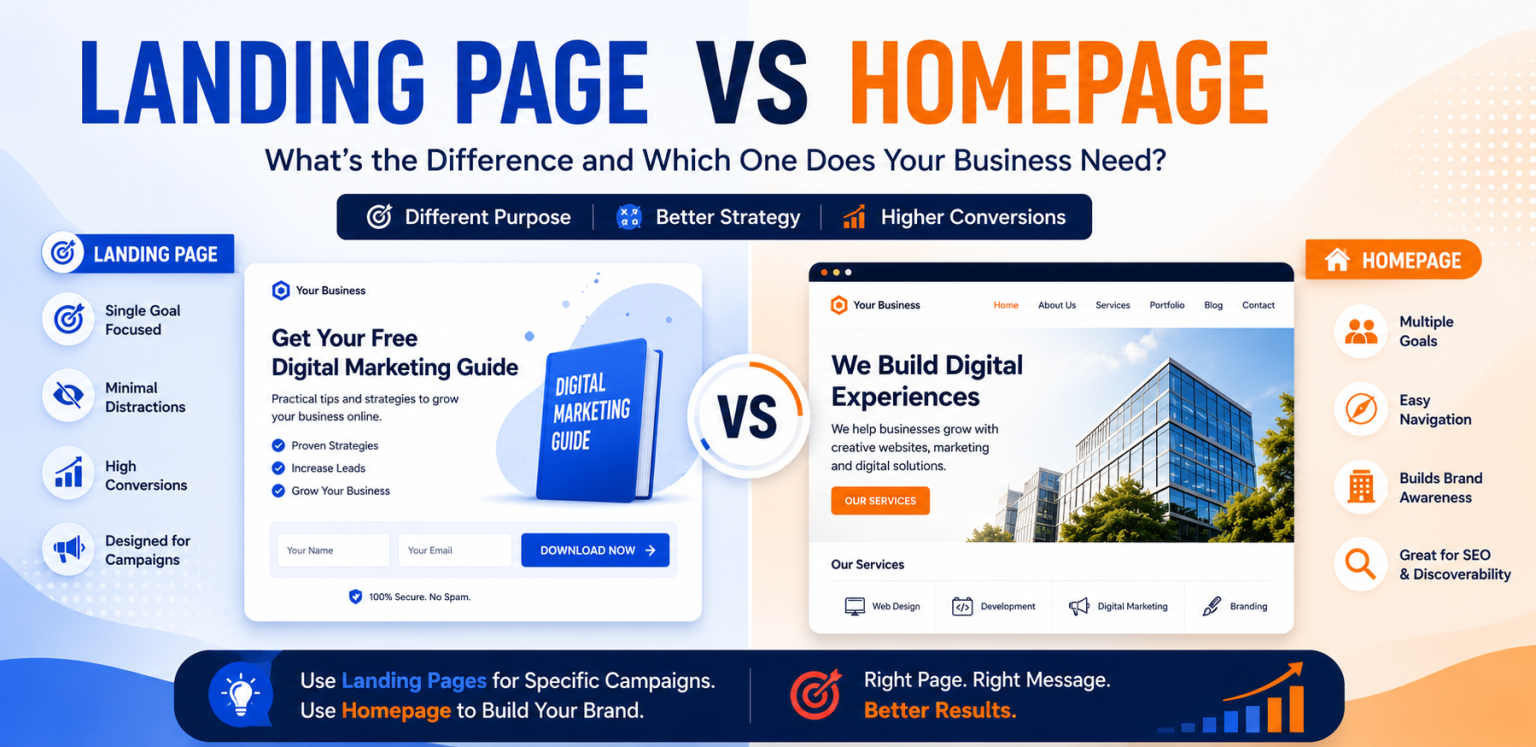
Although both pages are important, they serve different purposes. A homepage is designed to provide visitors with a complete overview of your business, while a landing page focuses entirely on achieving one measurable goal.
| Homepage | Landing Page |
|---|---|
| Introduces the entire business | Focuses on one offer or goal |
| Contains many navigation links | Minimal navigation |
| Multiple objectives | Single objective |
| Suitable for general visitors | Designed for campaign visitors |
| Encourages exploration | Encourages immediate action |
Every business website should have a well-designed homepage because it acts as the central hub of your online presence. Visitors who search for your company name or type your website address directly will usually arrive on your homepage first.
A homepage works best when your goal is to introduce your brand, explain your services, build credibility, and help visitors navigate throughout your website.
Landing pages should be used whenever you want visitors to perform one specific action. They are especially effective for Google Ads campaigns, Facebook advertisements, email marketing campaigns, seasonal promotions, product launches, and lead generation campaigns.
Because there are fewer distractions, visitors are more likely to complete the desired action instead of leaving your website.
There isn't a single answer to this question because both pages serve different purposes. A homepage helps visitors learn about your business and explore your services, while a landing page is specifically designed to convert visitors into leads or customers.
If someone searches directly for your company, they will usually visit your homepage. However, if someone clicks a Google Ads campaign, Facebook advertisement, email campaign, or promotional link, sending them to a dedicated landing page generally produces better conversion rates.
For businesses focused on lead generation, combining a professional homepage with multiple targeted landing pages often delivers the best results.
Not every landing page performs well. A successful landing page should immediately communicate value, build trust, and encourage visitors to take action without overwhelming them with unnecessary information.
The goal is to remove friction and make the decision process as simple as possible.
Many businesses invest in advertising but lose potential customers because their landing pages are poorly designed. Even a great marketing campaign cannot compensate for a confusing or slow landing page.
Avoiding these mistakes can significantly improve both user experience and conversion rates.
Landing pages play an important role in both paid advertising and search engine optimization. For Google Ads, a dedicated landing page improves ad relevance, enhances user experience, and can contribute to better campaign performance.
For SEO, optimized landing pages targeting specific services or keywords help search engines understand your content more effectively. They also provide visitors with highly relevant information, increasing the chances of engagement and conversions.
When combined with a strong homepage and quality website content, landing pages become a valuable asset for long-term digital marketing success.
Instead of choosing one over the other, successful businesses use both strategically. The homepage builds brand identity and provides a complete overview of the company, while landing pages support marketing campaigns and encourage visitors to take specific actions.
This combination creates a better user journey, improves lead generation, and maximizes the effectiveness of your digital marketing efforts.
A homepage and a landing page are not competitors—they are complementary tools that serve different purposes. Understanding when and how to use each one can significantly improve your website's performance and marketing results.
At Shree Trinetra Technology LLP, we design websites and landing pages that not only look professional but also focus on user experience, lead generation, and business growth. Every page should guide visitors toward a meaningful action while building trust and credibility.
As digital competition continues to grow in 2026, businesses that combine a strong homepage with purpose-built landing pages will be better positioned to attract qualified visitors, increase conversions, and achieve sustainable long-term success.
Whether you need a website, eCommerce store, SEO, or digital marketing, our experts are here to help you achieve your goals.
Get Free Consultation
Comments (0)
No comments yet