
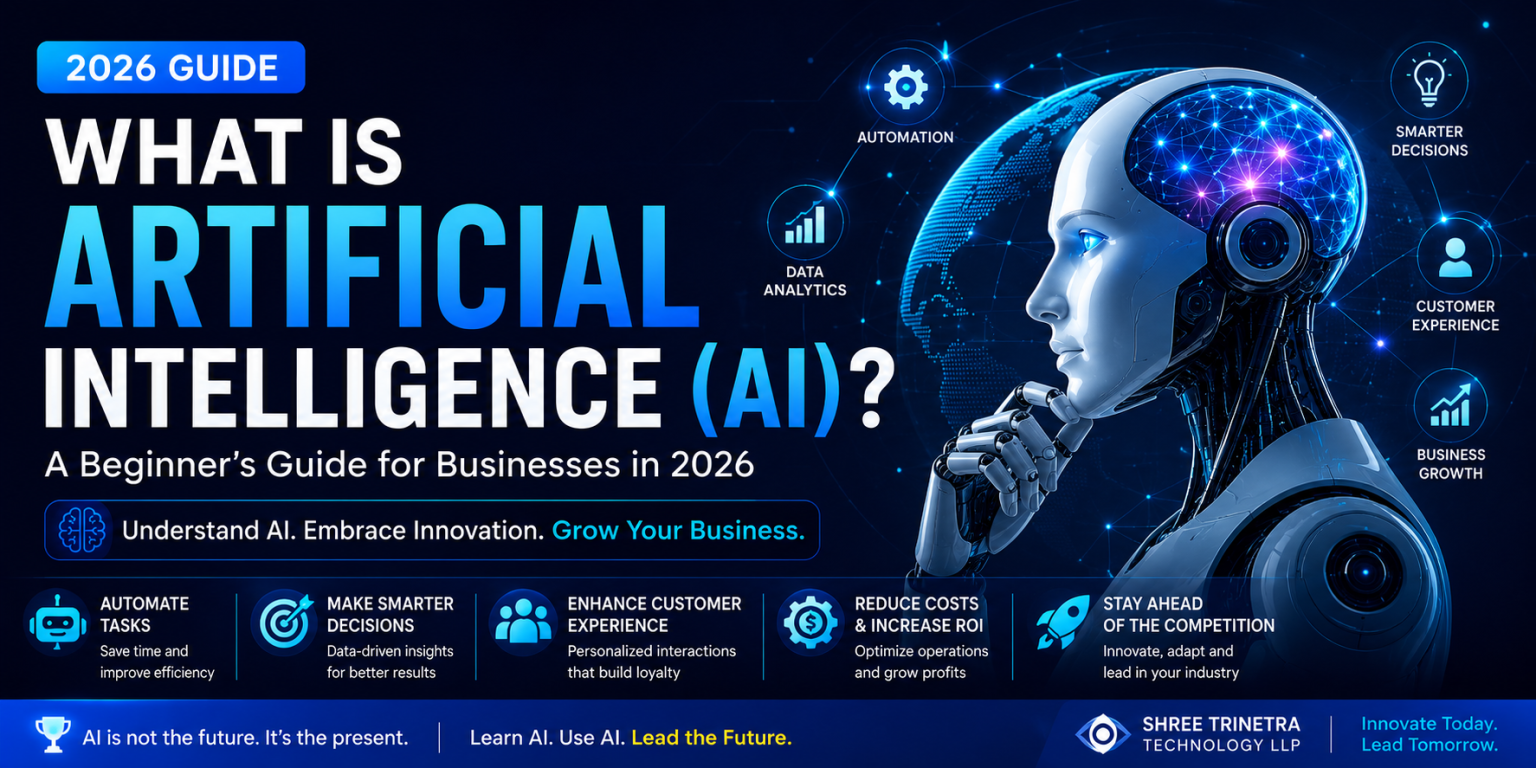
Artificial Intelligence (AI) is no longer a futuristic concept found only in science fiction movies. Today, it is transforming the way businesses operate, helping organizations automate processes, analyze large amounts of data, improve customer experiences, and make smarter decisions. Whether you're using AI-powered chatbots, personalized product recommendations, voice assistants, or content generation tools, Artificial Intelligence has become a part of everyday business operations.
Businesses of all sizes—from startups and small enterprises to global corporations—are increasingly adopting AI to improve efficiency, reduce operational costs, and stay competitive in an ever-evolving digital landscape. As AI technologies continue to advance, organizations that embrace innovation are better positioned to deliver faster services, improve customer satisfaction, and unlock new growth opportunities.
At Shree Trinetra Technology LLP, we believe Artificial Intelligence is not here to replace people but to empower businesses with smarter tools and better decision-making capabilities. Understanding AI is the first step toward leveraging its full potential.
In this beginner-friendly guide, we'll explore what Artificial Intelligence is, how it works, its major types, business applications, benefits, challenges, and why it is becoming one of the most influential technologies of 2026.
Artificial Intelligence (AI) refers to the ability of computer systems to perform tasks that normally require human intelligence. These tasks include learning from data, recognizing patterns, understanding language, solving problems, making decisions, and continuously improving performance based on experience.
Unlike traditional software, which follows predefined instructions, AI systems can analyze information, identify relationships, and generate intelligent responses using advanced algorithms and data models.
For example, when an email service automatically filters spam, a streaming platform recommends movies, or a virtual assistant answers questions, AI is working behind the scenes to provide intelligent and personalized experiences.
Artificial Intelligence has evolved from an emerging technology into a strategic business necessity. Organizations are no longer adopting AI simply to stay ahead of competitors—they are using it to solve real-world problems, streamline operations, and deliver more personalized customer experiences.
As digital transformation accelerates across industries, AI enables businesses to process vast amounts of information, identify trends, automate repetitive workflows, and make faster, data-driven decisions. This allows organizations to focus more on innovation, creativity, and customer relationships.
Artificial Intelligence works by combining data, algorithms, and computing power to identify patterns, make predictions, and continuously improve performance. Rather than simply following fixed instructions, AI systems learn from data and refine their responses over time.
Although AI technologies can be highly sophisticated, their basic workflow can be understood through a few essential stages.
Artificial Intelligence is powered by several advanced technologies that work together to simulate intelligent behavior. Understanding these technologies provides a clearer picture of how modern AI systems operate.
Artificial Intelligence can be classified in different ways based on its capabilities and intended purpose. While AI continues to evolve rapidly, understanding its primary types helps businesses recognize how different AI systems are applied in real-world scenarios.
Narrow AI is designed to perform specific tasks efficiently. Examples include virtual assistants, recommendation systems, chatbots, spam filters, and image recognition software. Most AI applications used by businesses today belong to this category.
General AI refers to a theoretical system capable of performing any intellectual task that a human can accomplish. While researchers continue to explore this concept, true General AI has not yet been achieved.
Generative AI creates new content such as text, images, videos, music, and computer code. Tools like ChatGPT and AI image generators have made Generative AI one of the fastest-growing technologies for businesses and creators.
Businesses across industries are adopting AI because it improves efficiency, enhances customer experiences, and enables smarter decision-making. Rather than replacing employees, AI often helps teams become more productive by automating repetitive tasks.
Artificial Intelligence is being used across almost every industry. Organizations are leveraging AI to streamline operations, improve services, and create innovative customer experiences.
| Industry | AI Applications |
|---|---|
| Healthcare | Disease prediction, medical imaging, patient monitoring |
| Education | Personalized learning, AI tutors |
| Retail | Product recommendations, inventory forecasting |
| Finance | Fraud detection, risk analysis, automated trading |
| Marketing | Content generation, customer segmentation, campaign optimization |
| Software Development | Code generation, testing, debugging |
Modern businesses use a variety of AI-powered tools to improve productivity, creativity, customer support, and software development.
Despite its growing popularity, several misconceptions continue to surround AI. Understanding the reality behind these myths helps businesses adopt AI more confidently.
Although AI offers significant advantages, businesses should also consider potential challenges such as data privacy, security, ethical concerns, implementation costs, and the need for high-quality training data. Responsible AI adoption requires transparency, continuous monitoring, and compliance with relevant regulations.
Artificial Intelligence will continue to reshape industries through smarter automation, predictive analytics, advanced robotics, personalized customer experiences, and faster decision-making. As AI technologies become more accessible, businesses of every size will have opportunities to innovate and compete more effectively.
Artificial Intelligence is no longer an emerging technology reserved for large corporations—it has become a practical business tool that organizations of all sizes can use to improve efficiency, enhance customer experiences, and support better decision-making. From automating routine tasks to generating valuable insights, AI is helping businesses work smarter rather than harder.
At Shree Trinetra Technology LLP, we help businesses embrace digital transformation by integrating modern technologies, including AI-powered solutions, intelligent automation, website development, and digital marketing strategies. Understanding AI today prepares businesses to remain competitive in an increasingly technology-driven marketplace.
As Artificial Intelligence continues to evolve in 2026 and beyond, organizations that invest in learning and adopting AI responsibly will be better positioned to innovate, improve operational efficiency, and deliver exceptional value to their customers.
Whether you need a website, eCommerce store, SEO, or digital marketing, our experts are here to help you achieve your goals.
Get Free Consultation
Comments (0)
No comments yet