
Every business wants more website visitors, more inquiries, and ultimately more customers. When planning a digital marketing strategy, one of the biggest questions business owners ask is whether they should invest in Search Engine Optimization (SEO) or Google Ads. Both strategies can generate traffic and leads, but they work in completely different ways.
Some businesses need immediate visibility and quick results, while others want sustainable, long-term growth without relying heavily on paid advertising. Choosing the right strategy depends on your business goals, budget, competition, and timeline.
At Shree Trinetra Technology LLP, we've helped businesses succeed with both SEO and Google Ads. Rather than treating them as competitors, we see them as complementary strategies that can work together to maximize online growth.
In this guide, we'll explain the differences between SEO and Google Ads, compare their benefits, and help you determine which approach is best suited for your business in 2026.
Search Engine Optimization (SEO) is the process of improving your website so that it appears higher in organic search engine results. Instead of paying for every visitor, SEO helps attract users naturally by creating valuable content, optimizing website performance, improving user experience, and targeting relevant keywords.
A successful SEO strategy focuses on helping search engines understand your website while providing users with useful, relevant, and trustworthy information. Although SEO requires patience, it often delivers sustainable traffic and long-term business growth.
Google Ads is Google's online advertising platform that allows businesses to display advertisements at the top of search results and across Google's advertising network. Unlike SEO, Google Ads provides immediate visibility because businesses pay whenever someone clicks on their advertisement.
This advertising model is commonly known as Pay-Per-Click (PPC), where advertisers only pay when users click their ads.
Google Ads is especially useful for businesses launching new products, running seasonal promotions, targeting competitive keywords, or generating leads quickly.
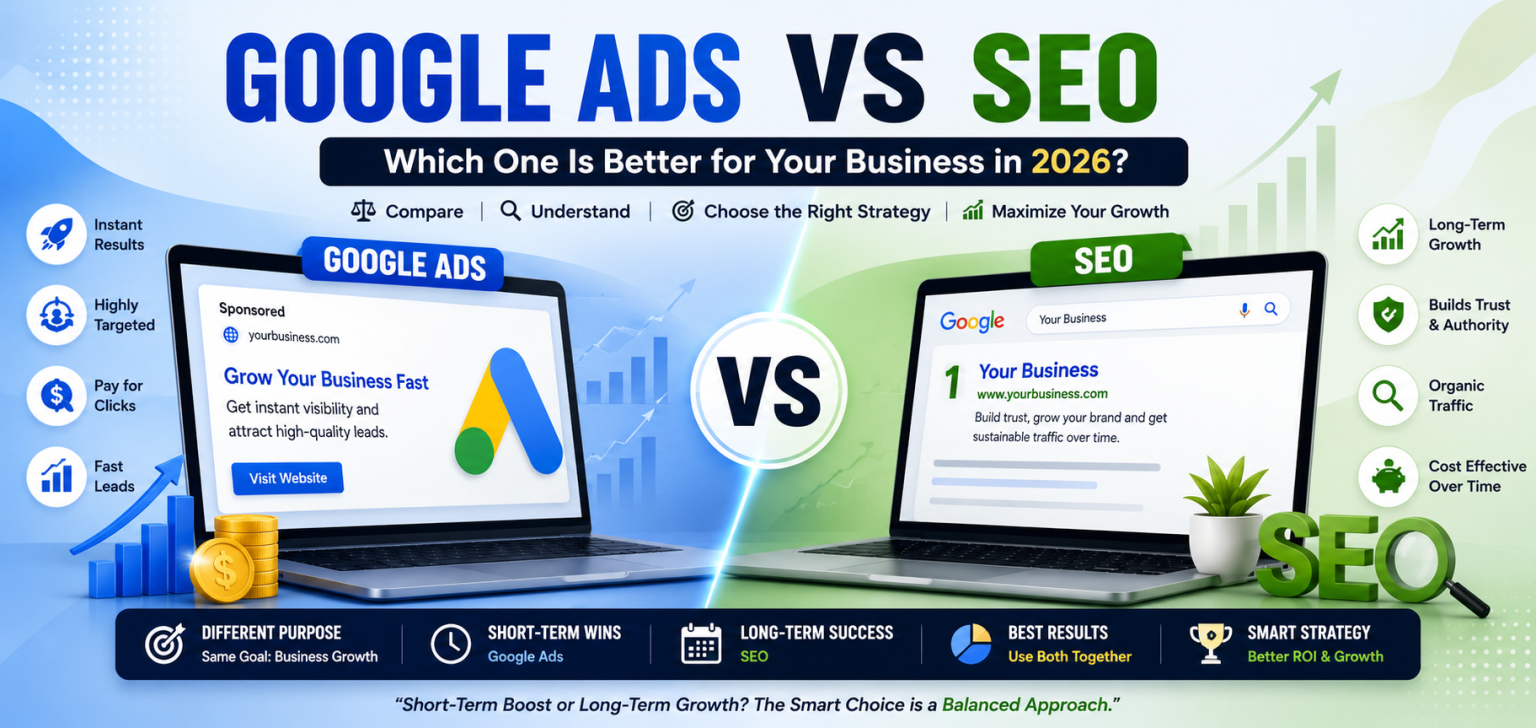
Although both strategies aim to increase website traffic, they achieve this in different ways. SEO focuses on earning organic visibility over time, while Google Ads provides immediate exposure through paid placements.
| SEO | Google Ads |
|---|---|
| Organic search results | Paid advertisements |
| Long-term strategy | Immediate results |
| No payment per click | Pay for every click |
| Requires continuous optimization | Requires continuous budget |
| Builds long-term authority | Delivers quick visibility |
One of the biggest differences between SEO and Google Ads is how businesses invest their marketing budget.
SEO usually requires ongoing investment in website optimization, technical improvements, quality content creation, and link-building efforts. While results take time, organic traffic continues even without paying for every visitor.
Google Ads, on the other hand, provides immediate traffic, but each visitor comes at a cost. Once your advertising budget is exhausted or campaigns are paused, traffic typically decreases significantly.
Google Ads is ideal when your business needs immediate results. Whether you're launching a new service, promoting a limited-time offer, or entering a highly competitive market, paid advertising can help you reach potential customers quickly.
It also allows businesses to target users based on keywords, location, demographics, devices, and search intent, making it one of the most precise advertising platforms available.
Return on Investment (ROI) is one of the most important factors when evaluating any marketing strategy. However, there is no universal answer because the effectiveness of SEO and Google Ads depends on your business objectives, industry competition, target audience, and available budget.
SEO usually delivers a higher long-term return because once your website begins ranking for valuable keywords, it can continue attracting visitors without paying for every click. Google Ads, on the other hand, provides immediate visibility and measurable results but requires continuous investment to maintain traffic.
Businesses looking for sustainable growth often benefit from SEO, while those seeking quick leads or promoting time-sensitive campaigns generally achieve better short-term results with Google Ads.
Small businesses often have limited marketing budgets, making it important to choose the right strategy. If your business is just starting and needs immediate inquiries or sales, Google Ads can help generate leads quickly. However, relying solely on paid advertising may become expensive over time.
Investing in SEO alongside Google Ads allows businesses to build a strong online presence while reducing future advertising costs. As organic rankings improve, businesses become less dependent on paid campaigns.
For many small businesses, the most effective approach is to use Google Ads for short-term visibility while simultaneously building a long-term SEO strategy.
Absolutely. The most successful digital marketing strategies rarely rely on a single channel. Combining SEO and Google Ads allows businesses to benefit from both immediate traffic and sustainable long-term visibility.
For example, Google Ads can help you generate leads while your SEO strategy gains momentum. At the same time, keyword data from advertising campaigns can help identify high-performing search terms to target through SEO content.
When both strategies are aligned, businesses often experience stronger brand visibility, increased website traffic, and higher conversion rates.
Many businesses struggle to achieve consistent results because they make strategic mistakes rather than choosing the wrong marketing channel.
Avoiding these common mistakes can significantly improve the effectiveness of your overall digital marketing efforts.
There is no one-size-fits-all solution. The right choice depends on your business goals, available resources, and growth timeline.
If you need immediate visibility and quick lead generation, Google Ads is an excellent choice. If your goal is to build long-term authority and reduce dependency on paid advertising, SEO should become a core part of your strategy.
For most businesses in 2026, combining both approaches delivers the strongest results by balancing short-term performance with sustainable growth.
SEO and Google Ads are both powerful digital marketing strategies, but they are designed to achieve different objectives. Rather than asking which one is better, businesses should focus on how each strategy can contribute to their overall marketing goals.
At Shree Trinetra Technology LLP, we help businesses develop integrated digital marketing strategies that combine SEO, Google Ads, high-performing websites, and conversion-focused landing pages. This balanced approach enables businesses to attract more qualified visitors, generate consistent leads, and build sustainable online growth.
Whether you're launching a new business or expanding an established brand, investing in both SEO and Google Ads can provide the flexibility, visibility, and competitive advantage needed to succeed in today's digital landscape.
Whether you need a website, eCommerce store, SEO, or digital marketing, our experts are here to help you achieve your goals.
Get Free Consultation
Comments (0)
No comments yet